
Creative
Graphic Designer Resume Example & Guide
For designers, the portfolio gets the job — but the resume gets the portfolio opened. It has to survive two very different readers: an ATS scanning for tools and keywords, and a creative director judging your taste from the document itself. A strong design resume is clean, honest about your role in each project, and puts the portfolio link where nobody can miss it.
Pro Resume Builder’s templates keep the document structured and parseable while you focus the content, and its ATS check scores your resume against a specific posting — worth doing, because agencies and in-house teams increasingly screen with tracking software before a human sees your work.
What a strong graphic designer resume shows
- A portfolio link that works. Your site or portfolio platform in the header, as a clean short URL. Test it in an incognito window — a broken or password-walled link ends the application.
- Tools at professional depth. Adobe Photoshop, Illustrator, and InDesign; Figma for product and web work; After Effects only if you genuinely do motion. List what you can defend in a working session.
- Deliverable range with your actual role. Brand identities, packaging, social and campaign assets, web and UI — each with whether you led, executed within a system, or supported. Creative directors respect precise credit.
- Production knowledge. Print: prepress, CMYK and Pantone, bleeds, dielines. Digital: export specs, asset systems, basic accessibility (contrast, type sizes). Production literacy separates working designers from portfolio-only candidates.
- Process under real constraints. Working from briefs, managing revisions and stakeholder feedback, and shipping on deadline — the professional skills that make talent usable.
- Results where they honestly exist. Engagement, conversion, or sales lifts only when they were measured and your work plausibly contributed — with credit shared accurately. Invented metrics read as exactly that.
A good template for graphic designer resumes
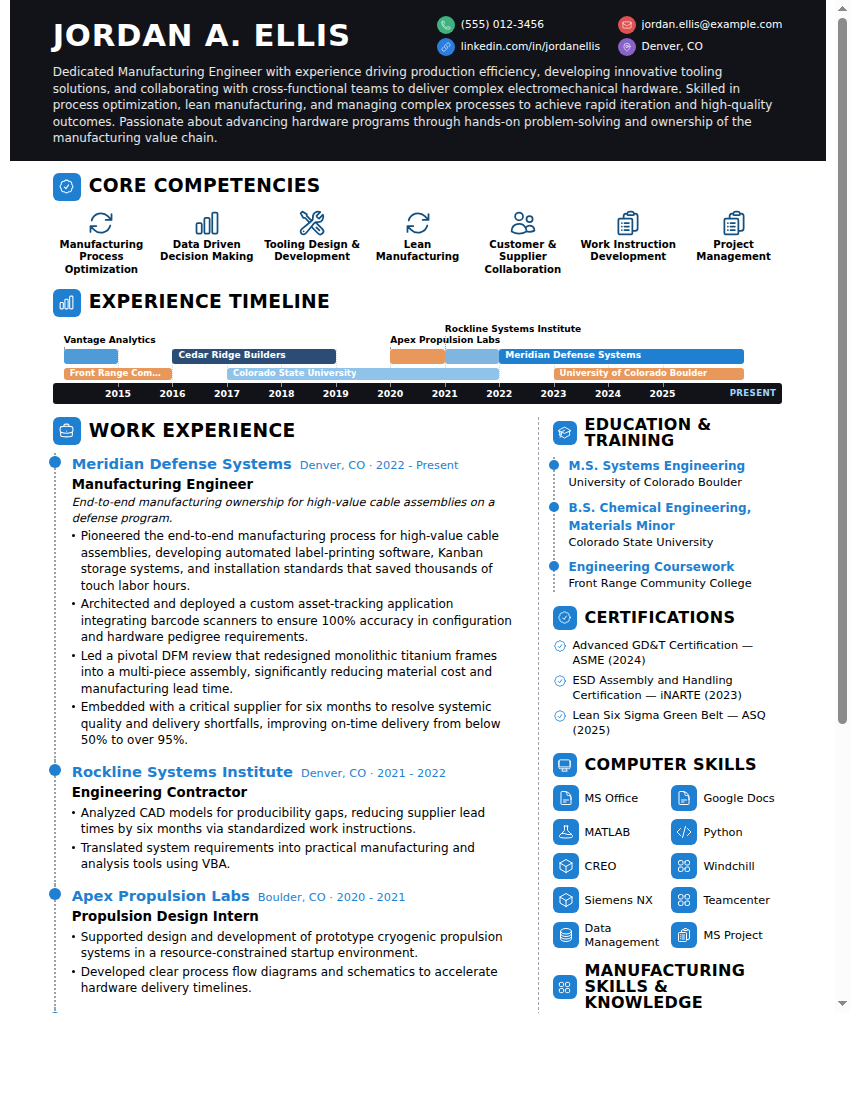
The Infographic template
The Infographic template’s visual-first layout — timeline and skill grids built from the same structured content as every template — fits a role where the resume itself is a design sample.
Every template is built from the same structured content, so you can switch designs without retyping anything.
Browse all templates →Frequently asked questions
Should my graphic design resume itself be heavily designed?
Restraint usually wins: strong typography, clear hierarchy, disciplined spacing. Many applications pass through tracking software that mangles elaborate custom layouts, so keep the resume structured and parseable and let the portfolio carry the visual fireworks.
How many portfolio pieces should the resume reference?
The resume needs the link; the portfolio needs curation — a handful of strong, relevant projects beats an archive of everything. If a posting is packaging-heavy, make sure packaging work is near the top of the portfolio the day you apply.
How do I credit team projects honestly?
State your specific contribution: "concept and art direction", "production design within an existing identity", "junior designer executing lead’s system". The design world is small, and accurate credit is both ethical and, over time, a reputation asset.
Freelance and contract work — one entry or many?
Group it under one "Freelance Graphic Designer" entry with dates spanning the period, then bullet notable clients or project types. This shows continuity instead of a wall of two-month stints, while staying entirely accurate.
Build your graphic designer resume with AI that speaks your field — and see how it scores against a real job posting before you apply.
Build your resumeQuestions about plans? See pricing