
Trades
Electrician Resume Example & Guide
An electrician resume has one job: show your license level, the code you work under, and the systems you have actually installed and troubleshot. Contractors and facilities managers skim for journeyman or master status, voltage classes, and whether your experience is residential, commercial, or industrial — everything else is secondary.
Set your career area to Trades in Pro Resume Builder and the AI writes in the vocabulary your reader expects — conduit, panels, code compliance — not generic corporate phrasing. The built-in ATS check compares your resume against a specific posting so you can see gaps before you apply.
What a strong electrician resume shows
- License and level up front. State journeyman or master electrician license (with the state), or your apprenticeship program and hours completed if you are still working toward it.
- Code you work under. Installations to the National Electrical Code (NEC), plus any local amendments you deal with regularly. Inspections passed on first walkthrough are worth a line.
- Systems and voltage classes. Services and panel installations, branch circuits, motor controls, low-voltage systems — and whether you work 120/240V single-phase, 480V three-phase, or both.
- Conduit and wire skills. EMT and rigid conduit bending, wire pulling, terminations, and panel makeup — the hands-on craft that distinguishes field electricians on paper.
- Troubleshooting ability. Fault isolation with multimeters and insulation testers, service calls resolved, and downtime restored — described concretely rather than as "problem-solving skills".
- Safety credentials. OSHA 10 or 30, NFPA 70E arc-flash training, and lockout/tagout practice. For industrial work these are often screening requirements.
A good template for electrician resumes
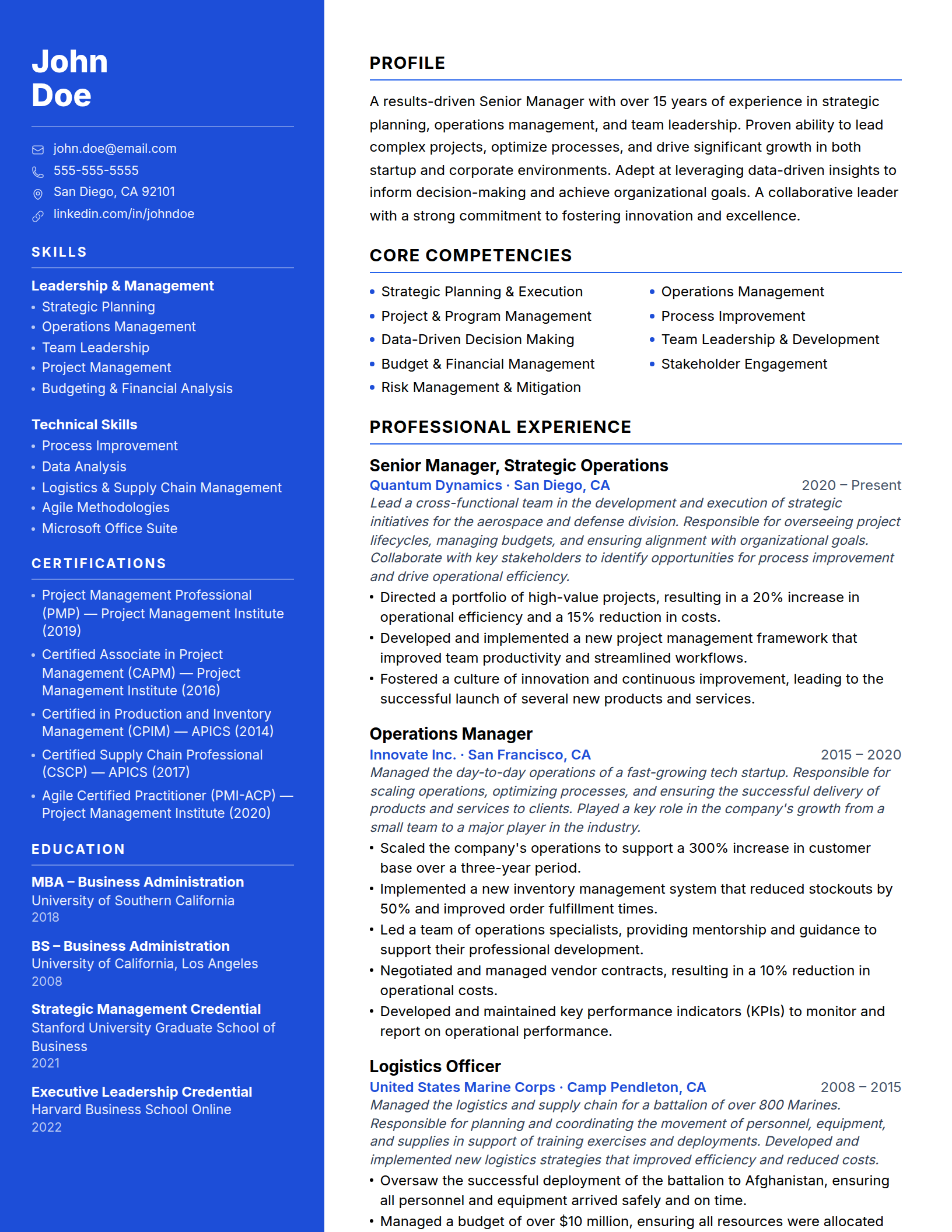
The Sidebar Professional template
The Sidebar Professional template gives your license, certifications, and system skills a dedicated rail, so the credential a contractor screens for is visible without scrolling.
Every template is built from the same structured content, so you can switch designs without retyping anything.
Browse all templates →Frequently asked questions
How do I show my electrician license on a resume?
Put it in a licenses/certifications section near the top: the license class (journeyman or master), the issuing state, and the license number if you are comfortable sharing it — many employers verify anyway. Apprentices should list their program, year, and hours completed.
I am still an apprentice — what do I put on my resume?
Lead with your apprenticeship: program name, current year, classroom hours, and the kinds of installations you have worked under supervision. Then list hands-on skills honestly — conduit bending, wire pulling, panel work — without inflating your independence level.
Residential vs commercial vs industrial — does it matter on paper?
Yes, a lot. Employers hire for the environment they staff, so label each job with the setting and typical work: "commercial fit-outs, 480V three-phase distribution" reads very differently from "residential service upgrades". If you span settings, say so — it widens your match.
Should I list tools and equipment on an electrician resume?
List diagnostic and specialty equipment (meggers, conduit benders, lift experience) rather than basic hand tools. Basic tools are assumed; test equipment and specialty skills are differentiators.
Build your electrician resume with AI that speaks your field — and see how it scores against a real job posting before you apply.
Build your resumeQuestions about plans? See pricing